
Watford Borough Council was to close on 1 April 2028, and its replacement would have had a leader, not a mayor. The government paused the plan on 7 September.
Update, 9 September 2026: this plan is paused. On 7 September the government put the Hertfordshire reorganisation under review, told councils to stop implementation work and confirmed that the May 2027 elections go ahead to existing council boundaries rather than to a shadow authority. No new date has been set for anything below. What follows is the decision as it stood in July, which is what the review is examining. Our report on the pause is here.
Watford voters elect their mayor directly. The government’s plans for replacing Watford Borough Council did not include one.
Two letters published on gov.uk after July’s reorganisation decision set out what comes next, and they carry detail the councils’ own announcements do not. The implementation letter sent to Hertfordshire chief executives on 21 July says the Structural Changes Order creating the new councils “will also provide duties to implement a Leader and Cabinet model”.
Under that model a council’s leader is chosen by elected councillors, not by voters directly. It is the standard arrangement in English local government. It is not the one Watford uses.
The mayoral term was already cut to two years
Watford voters last elected a mayor on Thursday 7 May 2026. The council’s own announcement of the result said residents were choosing “who should serve as Watford’s Mayor for the next 2 years”, rather than the usual four. (Watford Borough Council, 8 May 2026)
Peter Taylor, of the Liberal Democrats, was re-elected for a third consecutive term with 14,583 of the 27,768 votes cast, a share of 52.5 per cent. Turnout was 37.17 per cent. Mark Dixon of Reform UK was second on 4,972, followed by the Green Party’s Jake Mitchell on 3,084, Labour’s Keith Morgan on 2,742 and the Conservatives’ Abdul Laskar on 1,915. (Watford Borough Council, 2026 mayoral election results)
Two years from May 2026 runs to May 2028. Watford Borough Council was to be abolished on 1 April 2028, just before that term ended. With the abolition date now under review, nothing has been published about what happens to the mayoralty if the timetable slips.
What replaces the council
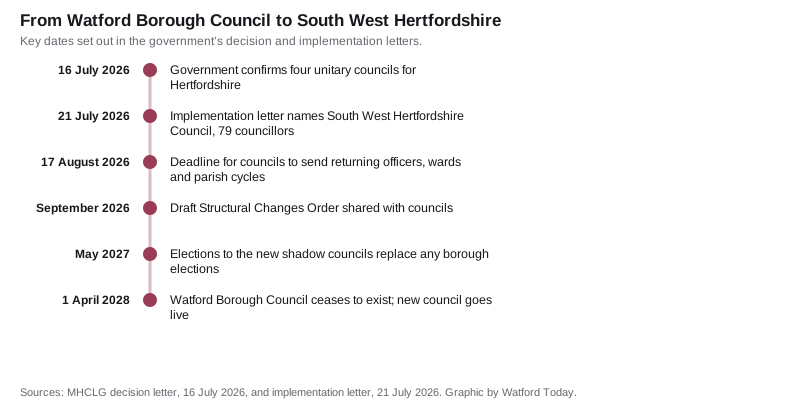
The implementation letter gave the new council a legal name and a size:
- it is South West Hertfordshire Council
- it covers Hertsmere Borough Council, Three Rivers District Council and Watford Borough Council
- it will have 79 councillors
- it was to go live on 1 April 2028, with elections to a shadow council in May 2027
That name is worth noting, because it is not the one the councils have been using. Watford Borough Council’s own announcement of the decision calls the four new authorities North West Hertfordshire, South West Hertfordshire, Central Hertfordshire and Eastern Hertfordshire. (Watford Borough Council, 16 July 2026) The implementation letter instead names them West Hertfordshire Council, South West Hertfordshire Council, Central Hertfordshire Council and East Hertfordshire and Broxbourne Council, noting in each case what the proposal had called them. Watford’s is the one name that survived unchanged.
During the transition the three councils sit on a joint committee of 12, made up of six members from the district and borough councils and six from Hertfordshire County Council. Each new unitary was to receive £900,000 from government towards transition costs, £3.6 million across Hertfordshire.
What the public actually said
The government also published its analysis of the consultation responses. It received 1,831 responses, 27 from named consultees such as councils and public bodies and 1,804 from everyone else.
No option drew more support than opposition. Averaged across the questions, the two unitary proposal was rated 39 per cent positive and 49 per cent negative; the three unitary proposal 29 and 54; and the four unitary proposal that was chosen 32 and 53. Among individuals living in Hertfordshire, the chosen option scored 31 per cent positive against 54 per cent negative.
The named consultees were the exception, and the only group to prefer the winning option: they rated it 50 per cent positive and 22 per cent negative.
A county mayor, but not a town one
While Watford’s own mayoralty ends, Hertfordshire is pursuing a different kind of elected mayor. The council’s announcement says the county “is seeking the establishment of a Strategic Mayoral Authority with a directly elected Mayor for Hertfordshire as soon as possible”, sitting above the four new unitary councils.
Watford also has no parish or town council tier to fall back on. Hertfordshire has 124 parish and town councils, and the borough council’s reorganisation page states plainly that there are none in Watford. In much of the county a parish council will survive reorganisation and keep a very local voice; in Watford there is nothing below the borough to inherit one.
Where it stands now
The 17 August deadline for councils to send the government their proposed returning officers, interim ward boundaries and parish election cycles has now passed. The same letter said ministers would consider further representations on names and councillor numbers if they came unanimously from all the councils in a new authority’s area by that date. No such representation for South West Hertfordshire has been published, and we could not confirm today whether one was made.
The draft Structural Changes Order was due to be shared with councils in September, after which it would have needed parliamentary approval. The pause announced on 7 September overtook that step, and the government has published no timetable for the review.
What it means for you
Your services do not change. Watford Borough Council remains responsible for bins, planning, parking, housing and licensing, and the pause makes no difference to any of them.
Your next council vote is in May 2027. It is now an ordinary borough election on existing boundaries, not a shadow council election. The government reversed that on 7 September.
Check you can vote in it. The council urged residents in July to confirm their electoral registration details. Registration is worth checking now rather than in 2027.
Planning is the thing to watch. Housing targets and local plan policy will eventually be set across Watford, Three Rivers and Hertsmere together. Our Watford planning news page follows applications and decisions in the borough.
Sources
- Local government reorganisation: implementation letter to Hertfordshire chief executives, 21 July 2026
- Local government reorganisation: decision letter to Hertfordshire council leaders, 16 July 2026
- Hertfordshire: summary and analysis of consultation responses
- Watford Borough Council, Local Government Reorganisation and Devolution
- Watford Borough Council, 2026 mayoral election results
Have your say