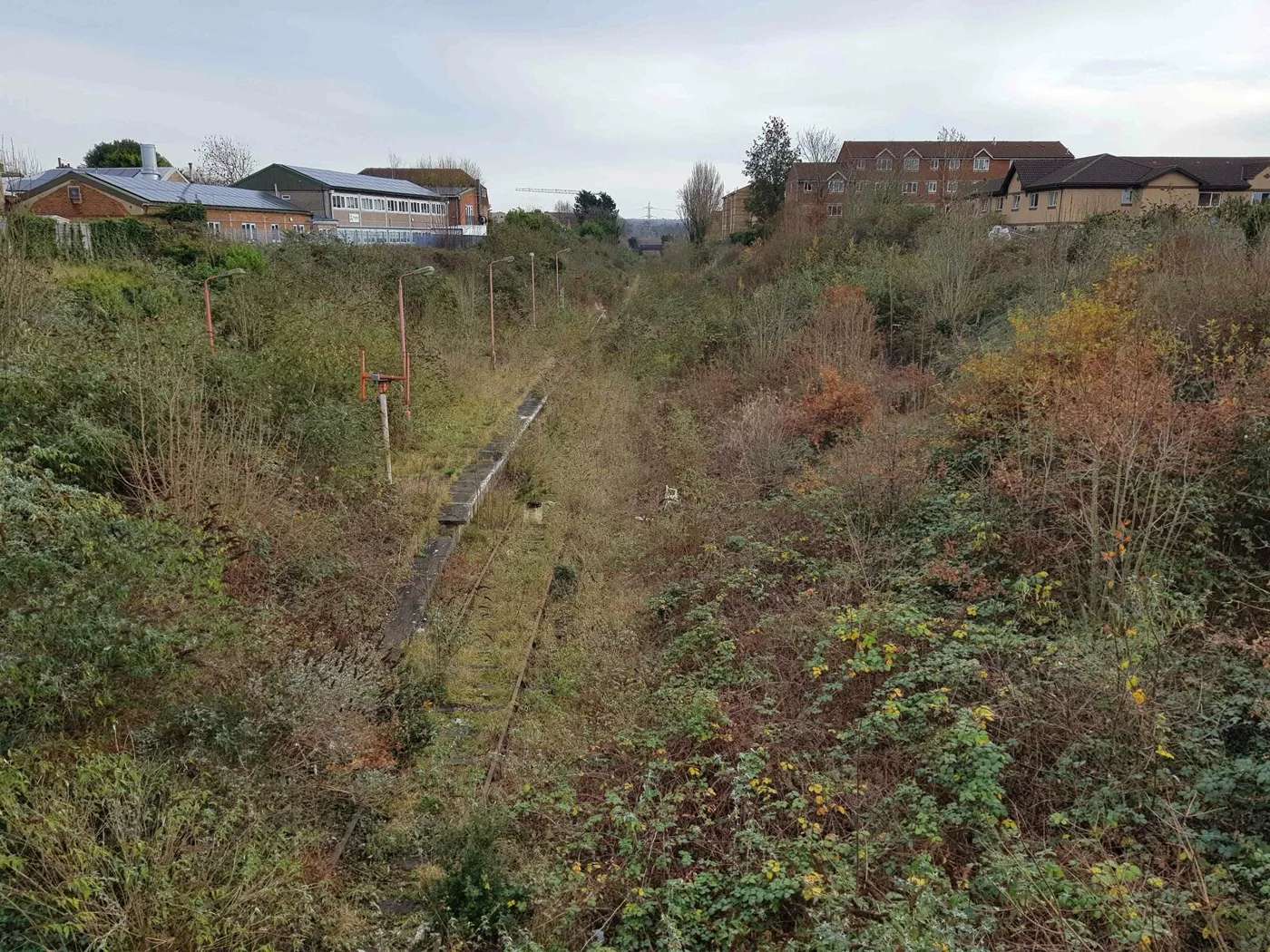

A trackless tram from Croxley station to Watford Junction, with 11 stops on the old branch line route, is the county's preferred plan. Comments close 4 December.
A trackless tram between Croxley station, just west of Watford, and Watford Junction is now Hertfordshire County Council’s preferred replacement for the abandoned Metropolitan line extension. The plan is in the draft strategy for the Hertfordshire Essex Rapid Transit, or HERT, and residents can comment on it until Friday 4 December.
The county opened the consultation on 23 October. You can respond through the online survey on Let’s Talk Transport or by email to HERT@hertfordshire.gov.uk.
A trackless tram is a long, battery-powered vehicle on rubber tyres that runs on ordinary roads. It has no rails or overhead wires. The draft strategy says the county chose it for “its flexibility, low cost and reduced delivery risk”.
The Watford route
The strategy calls this section the Watford to Croxley Link. It says partners including TfL, Network Rail, Watford Borough Council and Three Rivers District Council have been working on it since the Metropolitan line extension was abandoned.
The preferred route is 5.7km long. It would run:
- along the A412 Watford Road and Ascot Road
- onto the disused Croxley Green branch line from Ascot Road
- to Wiggenhall Road and alongside the Lioness line tracks to Watford High Street station
- along Exchange Road, Beechen Grove and Clarendon Road
- to Watford Junction
There would be 11 stops, which the strategy calls hubs:
| Hub | Note |
|---|---|
| Croxley Underground station | Terminus, with the car park developed into a hub |
| Baldwins Lane | |
| Ascot Road | |
| Tolpits Lane | |
| Vicarage Road | |
| Riverwell | |
| Dalton Way | Alternative route only |
| Watford High Street station | Lioness line to Euston |
| Beechen Grove | |
| Clarendon Road | |
| Watford Junction | Main hub, with rail, buses and over 750 parking spaces |
If the route beside the Lioness line cannot be delivered at first, an interim 6.4km route would use Dalton Way between Thomas Sawyer Way and Exchange Road. The High Street and King Street were both rejected because the town centre is pedestrianised.
How often, and how fast
The strategy proposes a tram every 10 minutes in each direction from 6am to 8pm. From 8pm to 11.30pm it would drop to every 20 minutes. The Watford to Croxley section would need about six vehicles.
The journey from Watford Junction to Croxley would take 14.1 minutes, the document says. It compares that with up to 18 minutes by car at peak times.
Earlier studies forecast that a 10-minute service would attract at least 540,000 extra public transport trips a year in the corridor by 2036. The strategy calls that figure conservative, because it leaves out people switching from existing buses.
When it might happen
Not soon. The strategy describes a gradual build:
- 2027 to 2035: “building blocks” such as bus priority, smoother road surfaces and hubs served by ordinary buses. Croxley to Watford Junction is one of the first places named, “to address the vacuum left by the abandoned MLX project”.
- 2035 to 2040: trackless trams start once demand and the network reach what the strategy calls “critical mass”.
- 2041: the opening year assumed in the cost-benefit appraisal.
The draft strategy gives no total cost for the scheme or for the Watford section. It lists possible funding sources, including government transport programmes, devolution settlements and developer contributions. It says an Atkins study in 2023 found a positive benefit-cost ratio for Watford to Croxley, without giving the figure.
The wider network, and the Abbey Line
The full HERT would run 67km from Hemel Hempstead and Croxley in the west to Harlow in Essex, through St Albans, Hatfield, Welwyn Garden City and Hertford. The county says it would serve 900,000 residents.
North Watford and Garston are covered differently. Between Watford Junction and St Albans the strategy keeps the existing Abbey Line, which stops at Watford North and Garston. It describes the current service as one train about every 45 minutes, with “low reliability”.
It does not propose a tram alongside it. Studies showed a second mass transit corridor between Watford and St Albans “would render both systems commercially and economically unviable”, it says. The railway “will be initially integrated into the HERT as it is”. Changes to it would come later, as the system matures.
What it means for you
If you live near the old branch line, look at the route maps. Pages 37 and 38 of the draft strategy show both the direct route and the Dalton Way alternative. Homes near Ascot Road, Tolpits Lane, Vicarage Road and Wiggenhall Road are closest to it.
The survey asks about the route, the hubs and the choice of vehicle. There is space at the end for other comments. The county says responses will feed into the final strategy. Its project page puts the consultation and the final strategy in the 2026 to 2027 stage.
Comments close on Friday 4 December. Our roadworks and travel page covers what is affecting Watford’s roads this week, and our train times guide covers the Lioness line and the Abbey Line.
Frequently asked questions
What is a trackless tram?
A long, articulated vehicle on rubber tyres, powered by batteries, that runs on ordinary roads like a bus. It needs no rails, signalling or overhead wires, which the strategy says keeps the cost of the fixed infrastructure down.
Is this the Croxley Rail Link?
It would serve the same purpose. The Metropolitan line extension, also called the Croxley Rail Link, was abandoned. The trackless tram would use much of the same disused branch line between Ascot Road and Watford High Street.
How do I respond?
Through the survey on the county’s Let’s Talk Transport site by 4 December 2026, or by email to HERT@hertfordshire.gov.uk.
Have your say